

WHAT MAKES A TEXT EASY OR DIFFICULT TO READ?
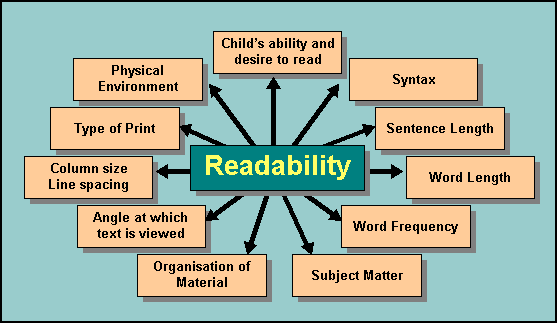 The process of determining the ease or difficulty of a text is called “readability.” As you can see by the image on the left, from masscommunicationtalk.com, there are many factors that impact the readability of a text for a particular reader at a particular time, ranging from the reader’s motivation and physical environment to the appearance and layout of the text.
There are several readability formulas – Fry, Flesch-Kinkaid and Dale-Chall, to name a few. Each is a little different, but all use some form of mathematical calculations based on the length of words and the length of sentences, on the assumption that longer words and sentences make for more difficult reading. High Interest Publishing has used several research-based formulas to come up with a system that provides grade-level readability for all of its novels. HIP is a also partnered with the Lexile Framework, a proprietary system of measuring difficulty of reading materials. See the Lexile levels of most HIP titles here. As well, many HIP titles have Accelerated Reader quizzes and levels. See the list here.
Measuring the reading difficulty, or “readability” of every title is an important part of HIP’s editorial process. Many publishers will provide an average readability score for an entire book; this means that potentially there will be some pages that are much more difficult than others. HIP editors analyze the readability of every page because we know that even a few challenging pages can boggle an already reluctant reader.
How accurate are grade-level readability scores?
Of course, any readability formula that is based on word and sentence lengths has its flaws; for example, single-syllable words such as brusque or schism may be more difficult to read than holiday or transportation. However, the extensive research base behind readability suggests that these calculations are a good starting point for assessing the reading difficulty of a text.
But reading level is not the same as grade-level appropriateness. Just because a book is written at Grade 2 reading level doesn’t mean that the content or vocabulary will be suitable for seven-year-olds. Matching a reader to a text requires not only an understanding of the difficulty of the text, but also the sophistication of the characters, situations, issues and plot lines.
What’s the difference between readability and leveling?
If readability is the science, leveling might be considered the art of assessing reading difficulty. Leveling is more subjective and considers page layout, illustrative support, vocabulary and overall text length, structure and genre. There are a number of leveling systems, such as Reading Recovery, Fountas & Pinnell and Developmental Reading Assessment (DRA), which tend to be used more often for beginning readers. It is difficult to “level” high interest-low vocabulary materials such as HIP books, because there is such a gap between the print features (reading level) and the sophistication of the content (interest level). If you would like to get a “level” for any specific HIP titles, please contact High Interest Publishing directly by phone or e-mail.
How does HIP control readability?
When publishing a novel, HIP’s top priorities are the appeal of the story, the authenticity of the characters and the fluency of the prose. HIP novels are written by accomplished YA authors and tested with students. Only then do HIP editors check the readability of every page. We reexamine the text to highlight challenging vocabulary and analyze whether a difficult word can be changed or supported with context clues without interfering with the meaning and flow of the text. We also look for sentences that are unnecessarily long or complex in structure; dysfluent readers can lose the gist of a sentence if there’s too much distance between the subject and predicate. It’s not difficult to shorten sentences; the challenge is to maintain the fluency and natural language of the narrative.
Finally, we have young readers read the books aloud so we can listen for problems that come up in oral reading or deal with confusions that arise. Fifty years of readability theory is important, but so are real kids.
Why is readability so important to HIP?
Because reading difficulty matters to reluctant readers. A competent reader has the confidence to tackle occasional challenges in a text. Struggling readers, on the other hand, often lack the self-monitoring strategies to identify and correct points of confusion. They are more likely to get bogged down in even a short section of challenging text and may give up on the reading entirely.
Years of reading failure take their toll on both the confidence and confidence of too many students. At HIP, our mission is to engage students with exciting stories, while building success with text that is accessible.
Does readability matter in other subject areas?
Too often, our content-area texts are two or more years beyond the grade levels of our students. An inability to read the material can lead to a lack of understanding of the subject. In fact, we may not realize it, but even our assignments and tests may be written at a level beyond the students. A simple check of the reading difficulty of a prompt or problem can help to ensure that our students aren’t penalized by a lack of ability to read the assignment.